
Complex Road Design with BIM
Modus Consult Gericke GmbH & Co. KG was commissioned by the Stuttgart Regional Council to upgrade the L 1107 highway between Bietigheim and Löchgau. The New Road Design module in card_1 was the software of choice, as it covered the complex requirements of the BIM traffic route project.
Digital methods and model-based approaches, such as BIM, are becoming increasingly important in the planning of infrastructure projects. The BIM method offers clear advantages, especially for complex projects. Project variants can be visualized early and realistically, interrelationships become immediately understandable, and planning decisions can be made based on a consistent, largely contradiction-free model. Conflict or clash detection, simulation-based construction sequences, and the ability to gradually expand the model to include further dimensions, such as time or costs, contribute to greater planning reliability and better coordination among all stakeholders.
A Case for BIM
The expansion of the L 1107 involved several design challenges, such as the construction of a bus lane on a section of the approx. 4 km long route, the integration of a pedestrian and bicycle path running parallel to the roadway, and the barrier-free upgrade of four bus stops. The planning of an intersection along the route also required a variant analysis to determine which intersection design would best optimise traffic flow.
In light of this, the Stuttgart Regional Council opted for BIM-based planning for the L 1107 upgrade. Modus Consult Gericke GmbH & Co. KG has been using the card_1 software solution since 2014. With the New Road Design module in card_1, a technology was available that consistently supports the BIM methodology and has suitable interfaces for BIM coordination tools such as DESITE BIM (now VDC Manager).
Classical Surveying
For the project, the client provided an IFC model of the existing road section. Based on this model, the basis for BIM-based design was established via traditional engineering surveying. The necessary backdrop maps were then created using mapping techniques. Although preparing the basic data for BIM proved time-consuming, this thorough groundwork paid off later in the project, for example, when calculating quantities and for cost calculation.
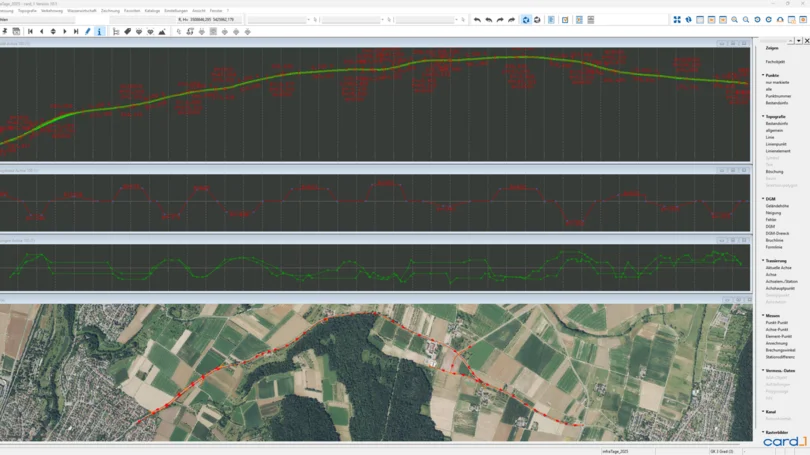
Routing and Road Design in card_1
Once the basis had been defined and a large part of the preliminary work completed, the next step involved routing in card_1. Based on the calculated alignment, the vertical alignments were optimised and dealt with separately for main and intersection alignments. For the route design according to RAL 2012, the Modus experts used the New Road Design module in card_1.
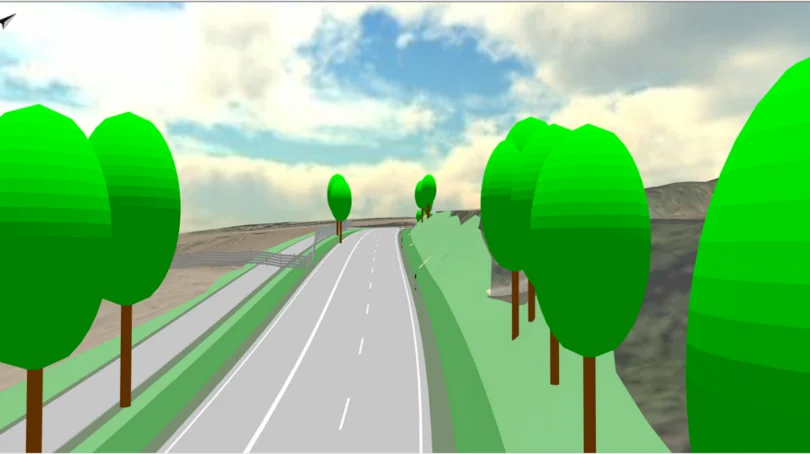
After entering various definition criteria and parameters in the dialog, such as road category, design class, and ATV value, the system modelled a three-dimensional, BIM-compatible road model based on the previously defined alignment and vertical alignment. The geometries were derived automatically and in accordance with regulation frameworks, with the minimum longitudinal gradients and cross falls continuously checked to meet drainage and driving dynamic requirements.
Fine-Tuning the Design
The integrated regulation frameworks and automation of the New Road Design significantly accelerated the process of developing the initial design for the L 1107 upgrade. In the subsequent steps, the project team was able to focus on the project’s specific design requirements and further develop the highway’s design.
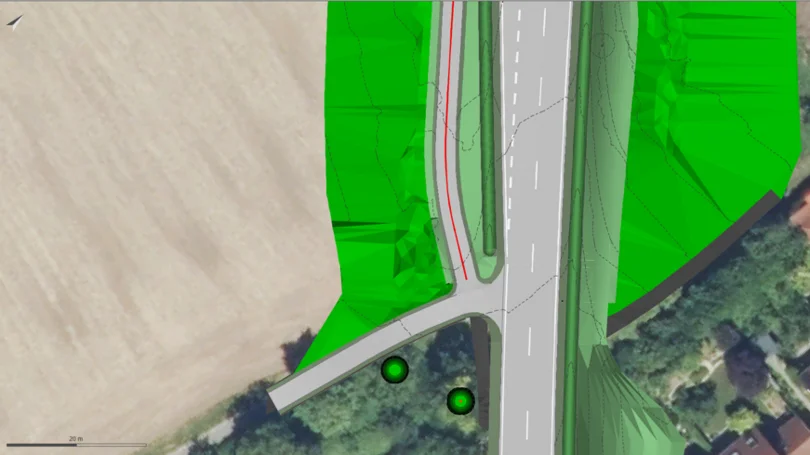
Among other things, the road was widened to accommodate a new bus lane. Subsequently, the existing bicycle path and a farm track, which run parallel to the L 1107, were connected by means of an intersection using the New Road Design. Designing the connection was achieved with the smart construction kit ConKit in card_1.
With just a few parameters, ConKit allows users to create and edit so-called tech-objects, which define the desired result – in this case, the intersection’s roadsides. Here, a predefined parameter set from the dialog was used and adjusted accordingly, so that the gaps were filled with an automatically triangulated surface. The roadside area was calculated automatically based on the previously selected technical properties, the parameters used, and the relationships to the existing objects around the intersection.
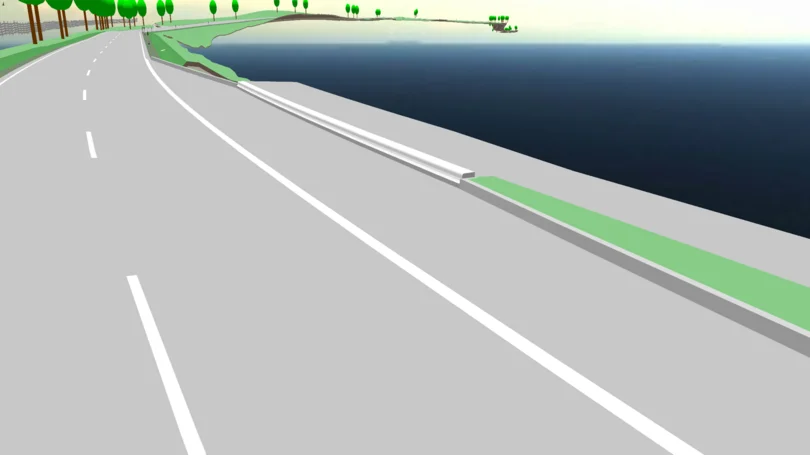
The Modus specialists also used this method when upgrading to barrier-free bus stops, creating a bus bay with markings using the unused space and the Baseline element. To design the bus bay lane markings according to the relevant specifications, the planners first assigned the appropriate elevations using topographic lines. The ConKit curb and gutter subassembly element was then locally modified using the Kasseler Sonderbord element.
Intersection Variants
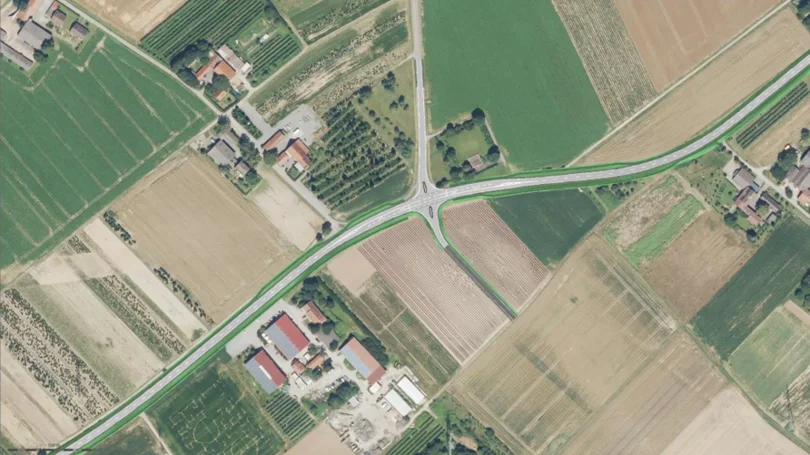
Also in need of an upgrade were the intersections along the project section of the L 1107. Variant analysis was required to determine the most suitable intersection design, in particular where the K 1633 merges into the L 1107, and where a farm access road in the form of a farm track was to be added.
The New Road Design module in card_1 allows for the automated calculation of intersections, such as junctions, crossroads, and roundabouts. The calculations conform to the RAL 2012 rules and standards, ensuring that exit and entry types are defined and represented in accordance with regulations. As a first step, the project team created a crossroads-type intersection. The K 1633’s pedestrian and bicycle paths were designed to cross the main road with a staggered offset alignment. In the next step, a dialog option allowed planners to adjust further details, such as the material for the farm track.
As part of the variant analysis, a roundabout was also considered as a possible intersection. However, since the L 1107 is the main traffic artery between Bietigheim and Löchgau, and less traffic volume is expected from the K 1633 and the farm track, the decision was made to use a classic intersection design.
Regulations-Compliant and Fast
Modus Consult Gericke GmbH & Co. KG draws a positive conclusion regarding card_1 and the planning of the BIM project. The New Road Design is a very complex tool that requires a certain amount of familiarization time. However, the results in the form of digital 3D models are a great advantage for BIM-compliant work. The thorough preparation of the basic data at the beginning of the project helped to carry out the calculation of quantities and cost calculation quickly and accurately in the BIM coordination tool DESITE BIM.
Furthermore, the New Road Design delivers compliant results quickly, which is particularly advantageous for variant analyses.
Contractor:
Modus Consult Gericke GmbH & Co. KG
Pforzheimer Str. 15b
76227 Karlsruhe
E-Mail to Modus Consult
www.modusconsult.net